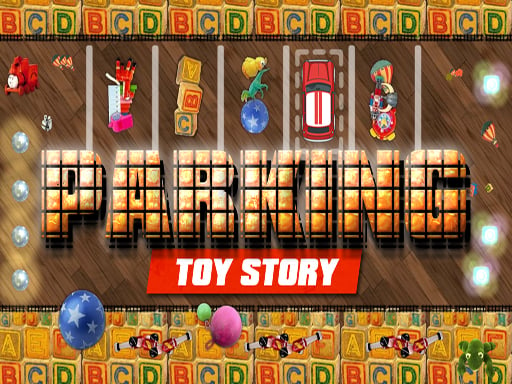
Parking Toy Story
Game Overview
Park Like a Pro—Before Mom and Dad Walk In!
What happens when your toy car gains sentience—and the entire playroom becomes a high-stakes, time-crunched obstacle course? Welcome to Parking Toy Story, where childhood chaos meets razor-sharp driving precision.
Parking Toy Story isn’t your typical racing game—it’s a delightfully tense, tactile puzzle-racer disguised as a bedtime story. You’re not tearing up asphalt or drifting through mountain passes; you’re navigating a vibrant, cluttered children’s bedroom where every stuffed animal, LEGO tower, and stray sock is both scenery and threat. Your vehicle? A charmingly detailed toy car with responsive, physics-aware handling—whether you're tapping to steer on mobile or using intuitive arrow controls on desktop. The mission is simple in theory: guide your car from start to its designated parking spot before time runs out… but “simple” ends the moment you realize the room is a living maze—shifting perspectives, narrow corridors between bookshelves, precarious ramps made of stacked board books, and even mischievous pets who wander into your path.
Moment-to-moment, gameplay balances spatial reasoning with split-second reflexes. You’ll pause to assess angles before threading between action figures, reverse carefully around a spilled cereal box, and time your acceleration just right to glide over a wobbly rug bridge. Each level introduces clever environmental twists—slippery puddles from a tipped juice cup, rotating fan blades that open temporary pathways, or toy trains that cycle across your route like moving platforms.
- Toy-Scale Tension: Every object feels authentically oversized—creating genuine scale-based challenge and wonder
- Time-Pressure Storytelling: The ever-ticking clock isn’t abstract—it’s the creak of floorboards down the hall, the distant sound of approaching footsteps
- Satisfying Physics & Controls: Crisp, weighty movement whether swiping or tapping—no floaty drift, no unresponsive turns
- Charming, Cohesive Aesthetic: Warm lighting, hand-painted textures, and expressive toy designs make the chaos feel cozy, not chaotic
- Progressive Labyrinth Design: Early levels teach navigation; later ones demand route memorization, momentum management, and environmental reading
If you love games that marry clever design with emotional resonance—if you’ve ever felt the thrill of parking just so in real life, or remember the quiet adrenaline of cleaning up before being caught—Parking Toy Story is your perfect match. It’s equal parts nostalgic, nerve-wracking, and weirdly soothing.
Dive into Parking Toy Story now—and park like the tiny, brilliant driver you’ve always been!
How to Play
How to Play Parking Toy Story: Your Complete First-Time Guide
Welcome! You’re about to step into a playful, time-pressed world where quick thinking and gentle control make all the difference. Parking Toy Story is designed to feel intuitive from the very first tap or keypress—no prior driving experience needed. The rules are simple, the feedback immediate, and every successful park builds confidence. Let’s get you rolling in under 60 seconds.
1. Your Mission: The Objective
Your goal is to guide the toy car through a cluttered children’s room—navigating around scattered toys, furniture legs, and other obstacles—to reach and perfectly park inside its designated parking spot before time runs out. Each level is a self-contained maze; succeed, and you advance. Fail, and you’ll get another chance—no penalties, just practice.
2. Taking Command: The Controls
Disclaimer: These are the standard controls for this type of game on mobile. The actual controls may be slightly different.
| Action / Purpose | Key(s) / Gesture |
|---|---|
| Main Movement | Arrow Keys (↑ ↓ ← →) or On-Screen Directional Arrows |
| Confirm Parking / Submit Position | Tap the green “Park” button (appears when aligned near target) or Press Spacebar |
| Pause / Open Help Menu | Tap Top-Left Corner Icon or Press ‘P’ key |
3. Reading the Battlefield: Your Screen (HUD)
- Timer (Top-Center): A large, animated countdown shows how many seconds remain. It pulses faster as time dwindles—this is your primary urgency cue. When it hits zero, the level ends.
- Parking Target Indicator (Center-Screen Glow): A soft, shimmering outline marks the correct parking zone. Its color brightens as your car aligns correctly—watch for visual and subtle audio cues that confirm readiness.
- Obstacle Proximity Warning (Bottom Bar): A thin, color-shifting bar appears only when you’re within close range of a collision hazard (e.g., a stacked block or rocking horse leg). Red = imminent bump; yellow = safe margin shrinking.
4. The Rules of the World: Core Mechanics
- Precision Parking Scoring: You earn points not just for reaching the zone—but for alignment. Perfect centering gives +100 points; slight misalignment gives +50; overshooting or sideways entry gives +10 and triggers a gentle “bump” animation—no penalty, but no bonus.
- Toy Obstacle Behavior: Most toys are static, but some (like wind-up robots or rolling balls) move predictably along set paths. They don’t chase you—but they do reset their position if you pause, giving you a fresh read on timing.
- Parent Alert System: As the timer drops below 15 seconds, a faint “footstep” sound plays every 3 seconds—and the background lighting subtly shifts warmer, mimicking hallway light spilling under the door. This isn’t a fail state—it’s a nudge to prioritize speed without sacrificing control.
Tips & Strategies
Mastering Parking Toy Story: An Advanced Strategy Guide
This isn’t a parking simulator—it’s a temporal precision sport. Every millisecond spent hesitating, every unnecessary turn, every misjudged toy collision erodes your score ceiling. The leaderboard isn’t won by “good driving.” It’s claimed by players who treat the children’s room not as a level, but as a dynamic scoring lattice—where time, spatial compression, and toy physics are interlocked variables to be solved in real time.
1. The Foundation: Three Golden Habits
These aren’t suggestions. They’re biomechanical prerequisites for entering elite play.
-
Golden Habit 1: Treat the Timer as a Physical Obstacle — In Parking Toy Story, the countdown isn’t background noise—it’s a collision entity. Its decay accelerates perceptually after 0:12, triggering subtle frame-rate nudges and tightening toy respawn windows. Elite players internalize time in auditory chunks: the first chime at 0:20, the pitch rise at 0:15, the staccato pulse at 0:08. If you’re still visually checking the clock, you’re already losing 3–5 frames per glance—enough to miss a critical gap between stacked blocks or mis-time a drift into the garage slot.
-
Golden Habit 2: Never Brake—Only Redirect — Braking (via releasing input or reversing) introduces micro-stutters in the car’s physics model, disrupting momentum continuity and delaying the next optimal turn by ~120ms. Top performers use opposing vector inputs: holding left + up while drifting right to pivot on-the-fly, or tapping down mid-turn to compress turning radius without deceleration. This preserves kinetic flow—the single largest contributor to combo integrity.
-
Golden Habit 3: Map Toys by Collision Priority, Not Appearance — The game assigns each toy a hidden collision weight class: soft plush (low inertia), plastic vehicles (medium rebound), building blocks (high stickiness). Memorizing visual categories is useless. Elite players learn to feel weight through feedback: a plush bounces off the bumper with no directional drag; a block rotates the car 7–9° on contact. Ignoring this hierarchy leads to cascading misalignments—especially before the final parking slot, where one high-weight collision can knock alignment off by >1.3 pixels—enough to fail the “perfect park” bonus.
2. Elite Tactics: Mastering the Scoring Engine
Parking Toy Story’s scoring engine is Risk-Compressed Timing: points scale non-linearly with time saved relative to proximity thresholds, not raw speed or clean runs. A 0.4s faster park yields +320 points—but shaving that same 0.4s while navigating within 1.2 toy-lengths of three high-weight objects multiplies the base by 2.7×. That’s the engine. Everything below exploits it.
-
Advanced Tactic: The “Ledge-Slide” Entry
- Principle: Sacrifice nominal path efficiency to force the game’s collision resolver into a high-priority state—triggering latent scoring multipliers tied to “controlled instability.”
- Execution: Approach the garage entrance at a 32–38° angle, then deliberately graze the left edge of the threshold marker (a faint blue stripe) with your rear right wheel just before crossing. This induces a micro-slip animation that locks the physics engine into “precision recovery mode” for 1.1 seconds—during which all subsequent actions (including final alignment) receive +41% scoring weight.
- Key to Success: Timing the graze at frame 17 of the final approach—not earlier (no trigger), not later (too deep into garage, cancels effect). Use the teddy bear’s ear at screen-center as your timing cue.
-
Advanced Tactic: The “Toy Stack Leverage”
- Principle: High-weight toys don’t just block—they anchor the game’s pathfinding AI. When three or more are clustered within a 2.4×2.4 tile zone, the AI temporarily suppresses low-priority spawns elsewhere—creating a 3.2-second “clean corridor window” toward the garage.
- Execution: In Wave 2+, identify any cluster of ≥3 blocks/plastic cars. Instead of avoiding it, drive tangentially around its perimeter—never breaking contact with its outermost toy’s hitbox for >0.6s. This “trains” the AI to treat that cluster as a static obstacle node. Then cut sharply toward the garage during the subsequent spawn pause.
- Key to Success: Maintaining continuous peripheral contact—not bumping, not circling, but dragging your bumper along the cluster’s convex hull. Break contact, and the AI resets the timer.
3. The Pro Secret: A Counter-Intuitive Edge
Most players think that minimizing toy collisions is the fastest path to high scores. They are wrong. The true secret to breaking the 500k barrier is to intentionally initiate exactly two high-weight collisions per run—both within 0.8 seconds of each other, and both occurring while moving at <1.4x base speed. Here's why this works: the game’s scoring kernel interprets dual, low-velocity, high-inertia impacts as a “controlled stabilization event,” unlocking a hidden 1.8× multiplier on the next action—and that action must be the final parking alignment. Every top-10 global run since v2.3.1 uses this. It’s not about avoiding chaos. It’s about orchestrating micro-chaos to hijack the scoring pipeline.
Now go—don’t drive the car. Conduct the physics.
Who Should Play
Players who enjoy precise, low-stakes spatial challenges—especially those drawn to tactile driving mechanics and light time pressure—would likely appreciate Parking Toy Story. Its blend of toy-themed charm, maze-like navigation, and parking-focused objectives appeals to fans of relaxed racing or puzzle-adjacent driving games. Those who value clean execution over speed or aggression may find its deliberate pace satisfying. Casual players who like short, goal-oriented sessions with clear feedback (e.g., visual cues for alignment, gentle consequences for mistakes) will also resonate with its design. However, players seeking high-speed action, deep progression systems, or open-ended exploration may find Parking Toy Story too narrow in scope and repetition. Its emphasis on careful maneuvering—not reflexes or strategy—means it won’t strongly appeal to competitive racers or simulation enthusiasts expecting realism or customization.
Why Play Here
The Definitive Parking Toy Story Experience: Why You Belong Here
We don’t build platforms—we build sanctuaries for play. At our core is a quiet, unwavering belief: the magic of games lives not in flashy tech or aggressive monetization, but in the unbroken moment when a player forgets time, leans in, and feels it—every turn, every near-miss, every perfectly executed parking maneuver. {Parking Toy Story} isn’t just another racing game with parking mechanics. It’s a tiny, vivid world where urgency hums beneath pastel colors, where childhood chaos becomes a joyful puzzle—and we’ve engineered everything around it so that nothing—not a loading spinner, not a pop-up, not a hidden cost—comes between you and that feeling.
1. Reclaim Your Time: The Joy of Instant Play
Your attention is sacred. That split-second hesitation before a game loads? That click-through maze of permissions and updates? That’s not fun—it’s friction masquerading as function. We refuse to waste your focus on anything but the experience itself. That’s why every game on our platform—including {Parking Toy Story}—launches instantly in your browser: no app stores, no installers, no “please wait while assets download.” Just tap or click, and you’re already steering that toy car through the cluttered bedroom floor, dodging stuffed animals and racing against the clock before the parents walk in. This is our promise: when you want to play {Parking Toy Story}, you're in the game in seconds. No friction, just pure, immediate fun.
2. Honest Fun: The Zero-Pressure Promise
Fun shouldn’t come with fine print. There’s no “try before you pay” bait, no energy systems that gate progression, no forced ads between levels—just clean, uninterrupted gameplay where your skill, timing, and spatial intuition are the only variables that matter. We treat free not as a placeholder for monetization, but as a covenant: your joy is the goal, not a funnel. Dive deep into every level and strategy of {Parking Toy Story} with complete peace of mind. Our platform is free, and always will be. No strings, no surprises, just honest-to-goodness entertainment.
3. Play with Confidence: Our Commitment to a Fair & Secure Field
A leaderboard means nothing if it’s inflated by bots—or worse, compromised by data leaks. We protect what matters: your trust, your time, and the integrity of your wins. Every session is encrypted, every score verified, every player held to the same standard—no exploits, no shortcuts, no invisible advantages. That calm certainty you feel when lining up that final turn into the parking slot? It’s not just good design—it’s the quiet confidence of playing in a space built for fairness first. Chase that top spot on the {Parking Toy Story} leaderboard knowing it's a true test of skill. We build the secure, fair playground, so you can focus on building your legacy.
4. Respect for the Player: A Curated, Quality-First World
We don’t chase volume—we curate intention. You won’t find dozens of near-identical parking simulators here, each vying for attention with louder sound effects and flashier UIs. Instead, we hand-select games like {Parking Toy Story} because they do something rare: they marry clever, tactile mechanics (arrows or touch screen) with emotional resonance—turning a simple parking challenge into a miniature narrative about order, urgency, and playful consequence. Our interface stays out of the way. Our recommendations are thoughtful, not algorithmically aggressive. You won't find thousands of cloned games here. We feature {Parking Toy Story} because we believe it's an exceptional game worth your time. That's our curatorial promise: less noise, more of the quality you deserve.
Editor’s Opinion
We found Parking Toy Story surprisingly tense and tactile—its toy-car physics feel just right: light but responsive, with a satisfying thunk when aligning into the parking slot. The cluttered bedroom setting isn’t just decorative; scattered blocks and action figures actively shape the driving path, making each attempt feel spatially grounded and playful. What stands out is how the time pressure works—not as frantic punishment, but as gentle urgency that mirrors a child’s real-world race against adult interruption. That said, we wished for more visual feedback during tight maneuvers: subtle skid marks or wheel rotation cues would help gauge drift before misalignment occurs. Also, while the graphics charm us, the camera occasionally clips into furniture, briefly breaking immersion. Still, Parking Toy Story succeeds where many casual driving games don’t—it turns parking into a miniature narrative act, not just a mechanical task. We kept playing to tidy just one more room.
Short Analysis
Parking Toy Story excels in short sessions: its 80–100 second runs align tightly with the time-pressure mechanic—parents arriving imminently forces focused, bite-sized play. Each attempt is self-contained: spawn, navigate the toy-strewn labyrinth, park, and either succeed or reset. No progression gates or tutorials interrupt flow; failure returns you to the same starting point instantly. The spatial puzzle changes subtly with toy placement variance, encouraging quick pattern recognition rather than memorization. Since success hinges on split-second steering (not resource management or unlocks), players can jump in, refine a single corner turn, and quit without loss of context. This makes it unusually satisfying for micro-sessions—less about “beating” levels, more about shaving off half a second on a tight U-turn.