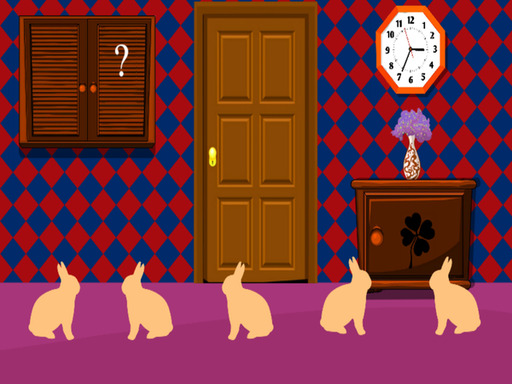
Coney House Escape
Game Overview
Escape the Enigma of Coney House Escape!
What if the most ordinary-looking house on the block held secrets that defied logic—and locked you inside with nothing but your wits? Coney House Escape isn’t just another escape room simulator—it’s a tightly crafted, atmospheric puzzle odyssey where every drawer, painting, and floorboard could hold the key to your freedom.
Developed by the consistently inventive 8B Games (also known as Games2mad), Coney House Escape plunges you into the quiet, slightly uncanny interior of a seemingly abandoned residence—Coney House. You didn’t break in; you woke up here. No exposition, no ominous voiceover—just silence, soft ambient light, and the growing realization that every exit is sealed, every window barred, and every clue deliberately placed. This isn’t about frantic searching—it’s about patient observation, lateral thinking, and trusting your instincts when a teacup doesn’t match the saucer… or when a bookshelf clicks twice.
In Coney House Escape, gameplay revolves entirely around intuitive mouse interaction: click to examine, drag to rotate objects, combine inventory items with environmental hotspots, and backtrack with fresh eyes when a solution eludes you. There’s no time pressure, no fail states—just the satisfying click of a mechanism engaging, the subtle shift of perspective when a hidden compartment slides open, and the slow, exhilarating unraveling of the house’s quiet narrative. Your objective is singular but layered: locate tools, decode symbols, reconstruct sequences, and ultimately trigger the final mechanism that swings the front door wide open.
- Atmospheric Point-and-Click Design: Every pixel feels intentional—creaky floorboards, faded wallpaper patterns, and softly shadowed corners build immersive tension without jump scares.
- Logical, Layered Puzzles: From simple object-based locks to multi-step environmental riddles requiring observation across rooms.
- Thoughtful Hidden Object Integration: Items aren’t scattered randomly—they’re contextually embedded in the world’s visual storytelling.
- No Inventory Overload: Clean, streamlined UI keeps focus on deduction, not item management.
- Self-Contained & Satisfying: A complete, polished 30–45 minute experience with a resonant, understated payoff.
If you savor the quiet thrill of spotting a discrepancy in a still life, love the dopamine hit of a perfectly timed “aha!” moment, or simply crave a puzzle game that respects your intelligence and your time—Coney House Escape is your next essential play. It’s proof that confinement can be captivating, and escape, deeply rewarding.
Dive into Coney House Escape today—and let curiosity, not chaos, be your compass out.
How to Play
How to Play Coney House Escape: Your Complete First-Time Guide
Welcome! You’re about to step into a quiet, slightly mysterious house—and your only goal is to find your way out. Don’t worry: there’s no time pressure, no fail states that lock you out, and no hidden knowledge required. Every clue is visible, every interaction is intuitive, and every puzzle unfolds naturally as you explore. With just your mouse and curiosity, you’ll be piecing together clues, uncovering secrets, and walking out the front door in minutes.
1. Your Mission: The Objective
Your sole objective is to locate and use all necessary items and clues to unlock the front door—and escape the house. There are no points to earn, no enemies to avoid, and no lives to lose. Success is measured in progress: each solved puzzle brings you one room closer to freedom.
2. Taking Command: The Controls
Disclaimer: These are the standard controls for this type of game on mobile. The actual controls may be slightly different.
| Action / Purpose | Key(s) / Gesture |
|---|---|
| Main Movement | Not applicable — camera is static per room; navigation is entirely via clicking |
| Primary Action (e.g., Shoot, Jump, Select) | Left Mouse Click (to examine objects, pick up items, or trigger interactions) |
| Secondary Action (e.g., Use Special Skill) | Right Mouse Click (to open/close inventory, rotate items, or access context-sensitive actions) |
3. Reading the Battlefield: Your Screen (HUD)
- Inventory Panel: Usually appears at the bottom of the screen when opened—it holds every item you’ve collected. You’ll need to drag-and-drop items onto objects in the scene to solve puzzles, so keep it accessible.
- Cursor Feedback: Your mouse pointer changes shape (e.g., turns into a magnifying glass over inspectable objects, a hand over grabbable items, or a gear icon over interactive mechanisms). This is your most reliable guide—never ignore it.
- Room Title/Exit Indicator: A subtle label (e.g., “Living Room” or “Front Hall”) often appears at the top center. When the front door becomes usable, it visibly changes—its handle glints, or a “Use” prompt appears—signaling you’re ready to leave.
4. The Rules of the World: Core Mechanics
- Examine Before You Act: Clicking any object first reveals its details—texture, markings, or hidden compartments. Skipping this step means missing critical clues (like a faint number etched under a rug or a loose floorboard that only creaks when clicked twice).
- Inventory-Driven Interaction: Items only become useful when combined with the right scene element—not with other inventory items. For example, a key opens a drawer, not a locked box labeled “keyhole,” unless that box is in the same room where the key was found. Context matters more than logic alone.
- Progressive Revelation: Puzzles are gated by discovery—not difficulty. You won’t encounter a code lock until you’ve seen the numbers written elsewhere in the same room (on a calendar, a receipt, or a child’s drawing). If something seems unsolvable, re-examine everything nearby—you missed a visual cue.
Who Should Play
Players who enjoy methodical, low-stakes puzzle-solving—especially those drawn to atmospheric, self-contained escape rooms—would likely appreciate Coney House Escape. Its emphasis on observation, inventory-based logic, and environmental storytelling suits fans of classic point-and-click adventures like Machinarium or The Room series. Those who savor subtle visual clues, tactile object interactions (via mouse), and a sense of quiet discovery over time pressure or narrative complexity will find it satisfying. It also appeals to players seeking accessible yet thoughtful challenges—no reflexes or multitasking required. However, players who prefer fast-paced action, rich character-driven narratives, or open-ended exploration may find Coney House Escape too restrained or linear. Its minimalist presentation and singular goal mean it won’t resonate with those who prioritize variety, progression systems, or high production polish.
Why Play Here
The Definitive Coney House Escape Experience: Why You Belong Here
This isn’t just another place to click and play. It’s where intention meets immersion—where every technical decision, every design choice, every line of code is made with one purpose: to dissolve the distance between you and the thrill of discovery. We don’t ask you to adapt to the platform. We adapt everything—so that when you step into Coney House Escape, you step fully into the mystery, the quiet tension of a locked door, the satisfaction of a puzzle clicking into place. We handle all the friction, so you can focus purely on the fun.
1. Reclaim Your Time: The Joy of Instant Play
Your curiosity shouldn’t wait. That spark—the sudden urge to explore a creaky hallway, test a dusty drawer, or re-examine a painting’s frame—deserves immediacy, not a loading spinner or an install prompt. We treat your attention as sacred, never transactional. That’s why every game on our platform runs natively in modern browsers, with zero downloads, zero plugins, and zero setup. This is our promise: when you want to play Coney House Escape, you're in the game in seconds. No friction, just pure, immediate fun.
2. Honest Fun: The Zero-Pressure Promise
There’s real dignity in play that asks nothing in return—not your email, not your credit card, not your patience while ads hijack your focus. We believe joy shouldn’t be gatekept, and engagement shouldn’t be engineered through exhaustion. Our platform is built on hospitality, not extraction. Dive deep into every level and strategy of Coney House Escape with complete peace of mind. Our platform is free, and always will be. No strings, no surprises, just honest-to-goodness entertainment.
3. Play with Confidence: Our Commitment to a Fair & Secure Field
You deserve more than just access—you deserve assurance. Assurance that your progress reflects your attention and intuition, not luck or loopholes. Assurance that your data stays yours, and that the world you enter—however surreal or suspenseful—is governed by integrity, not algorithms designed to nudge or trap. We enforce strict anti-cheat protocols, anonymize analytics by default, and ban intrusive tracking. Chase that top spot on the Coney House Escape leaderboard knowing it's a true test of skill. We build the secure, fair playground, so you can focus on building your legacy.
4. Respect for the Player: A Curated, Quality-First World
We don’t flood you with noise to chase metrics. We curate with care—because we know you’re not scrolling for filler; you’re seeking resonance. Every game we feature passes a simple but rigorous test: does it invite presence, reward observation, and honor the player’s intelligence? Coney House Escape does exactly that: its deliberate pacing, tactile mouse interactions (Mouse Interact), and layered environmental storytelling reflect craftsmanship—not convenience. You won't find thousands of cloned games here. We feature Coney House Escape because we believe it's an exceptional game worth your time. That's our curatorial promise: less noise, more of the quality you deserve.
Editor’s Opinion
We found Coney House Escape a pleasantly compact escape experience—tight in scope but thoughtful in execution. Its strongest point is the environmental storytelling: subtle visual cues, like faded photographs and mismatched furniture, quietly suggest a lived-in, slightly unsettling history without over-explaining. That atmosphere elevates the standard “find keys and codes” loop into something more evocative. That said, we ran into occasional pixel-perfect interaction issues—especially with small inventory items that refused to combine unless clicked in an exact spot, breaking flow more than once. A slight UI refinement, like hover highlights or clearer feedback on failed actions, would go a long way. The puzzles themselves are fair and logically sequenced, though none feel particularly novel; they serve the mood rather than surprise. Still, for a quick, self-contained session—around 20 minutes—we appreciated its restraint and quiet cohesion. It doesn’t try to be more than it is, and that’s refreshing.