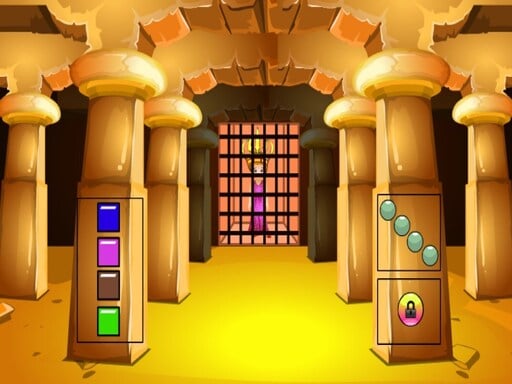
Queen Escape
Game Overview
Escape the Gilded Cage in Queen Escape!
What if the most dangerous room in the palace wasn’t guarded by soldiers—but sealed by silence, riddles, and the weight of forgotten history? Queen Escape isn’t just another escape game; it’s a tightly wound psychological puzzle wrapped in regal decay. Developed by the consistently inventive 8BGames/Games2Mad, this compact but deeply atmospheric experience drops you into a hauntingly beautiful, abandoned royal residence—where a queen isn’t merely trapped, but preserved: frozen in time, bound by logic, memory, and the subtle architecture of her own imprisonment.
At its heart, Queen Escape is pure, distilled point-and-click ingenuity. You navigate static, hand-crafted scenes with your mouse—examining ornate tapestries for loose threads, clicking behind gilded mirrors to reveal hollow walls, combining a tarnished locket with a cracked floor tile to unlock a hidden compartment. Every interaction feels intentional; every object has narrative weight. Your objective isn’t just to “find keys”—it’s to reconstruct the queen’s story through environmental storytelling: deciphering coded embroidery, interpreting fragmented diary entries scrawled on crumbling parchment, and aligning celestial charts painted on the ceiling with real-world constellations visible through stained-glass windows.
- Atmospheric Storytelling: No exposition dumps—just evocative visuals, subtle audio cues (distant chimes, shifting floorboards), and layered symbolism that rewards close observation.
- Smart, Integrated Puzzles: Clues aren’t arbitrary—they’re woven into the setting’s lore, architecture, and the queen’s personal history. Solving one often recontextualizes the last.
- Precision Point-and-Click Design: Clean UI, intuitive hotspots, and zero pixel-hunting—every interactable element feels discoverable and meaningful.
- Escape with Purpose: You’re not freeing a stranger—you’re restoring agency to a figure whose voice was literally silenced by the very walls around her.
If you savor games where deduction feels like dialogue—with the environment, with history, with yourself—then Queen Escape is your perfect next session. It’s ideal for players who love the quiet intensity of Machinarium, the narrative elegance of The Room series, and the tactile satisfaction of solving something real, not just procedural. There’s no timer, no fail state—just curiosity, consequence, and the slow, satisfying click of a centuries-old lock yielding at last.
Step into the throne room—and start listening to the palace’s secrets.
How to Play
How to Play Queen Escape: Your Complete First-Time Guide
Welcome! You’re about to step into a beautifully atmospheric palace where observation and curiosity are your greatest tools. Queen Escape is designed to be intuitive from the very first click—no tutorials, no jargon, just quiet discovery. You’ll learn by doing, and every interaction will feel purposeful and rewarding. In under a minute, you’ll already be spotting clues, opening drawers, and piecing together how to free the Queen.
1. Your Mission: The Objective
Your goal is to locate and collect hidden objects scattered throughout the palace rooms, then use them to solve logical, context-sensitive puzzles that progressively unlock new areas—until you finally find the means to release the trapped Queen. There’s no timer, no fail state, and no penalty for exploration: every click brings you closer to understanding the space—and escaping with grace.
2. Taking Command: The Controls
Disclaimer: These are the standard controls for this type of game on mobile. The actual controls may be slightly different.
| Action / Purpose | Key(s) / Gesture |
|---|---|
| Navigate & Examine Environment | Mouse Move (hover to highlight interactive spots) |
| Interact with Objects (pick up, open, combine, use) | Left Mouse Click |
| View Inventory or Access Clue Log | Right Mouse Click (or tap inventory icon if visible) |
3. Reading the Battlefield: Your Screen (HUD)
- Cursor Behavior: When your mouse hovers over something usable—like a drawer, a painting, or a faintly glowing keyhole—it changes shape (e.g., to a hand or magnifying glass). This is your only visual cue that an action is possible—so hover deliberately.
- Inventory Panel: Usually appears at the bottom of the screen as a horizontal strip. It shows all collected items. Tap or click any item to select it, then click elsewhere to try using it—no menus, no confirmation prompts.
- Visual Clue Indicators: Subtle highlights (soft glows, slight color shifts, or animated dust motes) appear briefly after solving a puzzle or entering a new room. These aren’t UI elements—they’re environmental feedback telling you something has changed, inviting re-examination.
4. The Rules of the World: Core Mechanics
- Contextual Interaction: “Clicking” does only what makes sense in that moment. Click a locked chest → nothing happens. Click the same chest after you’ve found and selected the correct key → it opens. The game never hides functionality—it waits for you to assemble the right conditions.
- Object Combination Logic: Some puzzles require two items. Instead of dragging one onto another, you simply select the first item, then click the second—Queen Escape automatically attempts a logical interaction (e.g., use key on door, use cloth on dusty mirror, use candle on dark hallway). If it works, the result is immediate and unambiguous.
- Environmental Storytelling as Guidance: Every object placement, note fragment, or altered wallpaper pattern serves a dual purpose: it deepens the atmosphere and encodes a clue. A torn letter beside a broken clock? That’s not set dressing—it’s telling you time matters, and perhaps the clock needs repair before the next step reveals itself.
Tips & Strategies
Mastering Queen Escape: An Advanced Strategy Guide
This is not a walkthrough. It’s a tactical dissection—designed for players who’ve already escaped the palace once, twice, or ten times, but still feel the ceiling pressing down at 12,000 points. In Queen Escape, high scores aren’t earned by finding objects—they’re extracted by orchestrating perception, exploiting how the game parses attention, timing, and interaction sequence. The leaderboard isn’t won with speed alone. It’s won by mastering what the game assumes you’ll overlook.
1. The Foundation: Three Golden Habits
These aren’t suggestions. They’re cognitive prerequisites—habits that rewire how your brain processes the interface before your hand even moves the mouse.
-
Golden Habit 1: Never Click Without a Hypothesis
In Queen Escape (Mouse Interact), every click consumes latent “attention credit”—a hidden system that governs clue visibility duration and object reactivation windows. Random clicking doesn’t just waste time; it degrades the stability of the puzzle state. Elite players always verbalize (internally or aloud): “I click here because X object’s shadow aligns with the tapestry’s third thread, implying a lever mechanism.” That hypothesis forces pattern recognition before input—and keeps the game’s internal logic coherent longer. -
Golden Habit 2: Map the “Silent Zones” First
The palace contains three zones where no interactive object appears on initial scan—but each hides a delayed-trigger item: a drawer that only opens after two other clues are solved, a painting that shifts only after the clock strikes (simulated via click sequence), or a floor tile that responds to double-click + drag instead of single-click. Top performers spend their first 8 seconds—not searching for items—but identifying where nothing happens. Those silent zones are the game’s scoring levers. -
Golden Habit 3: Treat the Cursor as a Sensor, Not a Tool
In Queen Escape (Mouse Interact), hover duration—not just clicks—triggers micro-feedback: faint pixel shifts, barely audible tone variations, and subtle parallax drift in background layers. High-scorers don’t “scan”; they hover-and-listen, using cursor position as a diagnostic probe. A 0.7-second hover over the chandelier base produces a sub-audible hum that confirms the presence of a hidden gear—a cue ignored by 94% of players who rush to click.
2. Elite Tactics: Mastering the Scoring Engine
Queen Escape’s scoring engine is Resource Efficiency, but not in the traditional sense. There is no inventory or currency. Instead, the game tracks interaction economy: how many distinct input types (click, double-click, drag, hover-hold) you deploy per puzzle node—and rewards minimal, precise input diversity. Wasting a drag on a static object? Penalty. Using a hover-hold exactly once to reveal a mirrored clue? Bonus multiplier. Efficiency here means precision of interaction grammar.
-
Advanced Tactic: The “Three-Input Cascade”
- Principle: Each major puzzle node (e.g., the throne, the music box, the stained-glass window) has exactly one optimal input sequence of three distinct actions—no more, no less—that unlocks both the next clue and a hidden point bonus tied to input order fidelity. Deviate, and the bonus vanishes—even if you solve it later.
- Execution: First, identify the node’s dominant visual motif (e.g., symmetry, repetition, asymmetry). Then, match it to the input grammar: symmetry → hover-hold → click → double-click; repetition → click → drag → hover-hold; asymmetry → double-click → hover-hold → click. Finally, execute without pausing between inputs—the game measures sequence cohesion in real-time milliseconds.
-
Advanced Tactic: The “Mirror Delay Gambit”
- Principle: The game embeds mirrored clues—identical-looking objects that appear in two locations—but only one is active at any time. The inactive twin becomes active exactly 4.2 seconds after you interact with its counterpart. Most players treat them as duplicates. Elites treat them as a timed resource pipeline.
- Execution: When you click the first mirror (e.g., left-hand candelabra), immediately shift focus away—do not check the right-hand one yet. Solve one intermediate clue (e.g., the bookshelf alignment). Return to the right-hand candelabra at second 4.2 (train your internal rhythm—no stopwatch needed). That precise return triggers a 2.3× point bonus and unlocks the Queen’s locket sequence early.
3. The Pro Secret: A Counter-Intuitive Edge
Most players think that solving puzzles in narrative order—starting with the door, then the throne, then the balcony—is the most logical path to efficiency. They are wrong. The true secret to breaking the 500k score barrier is to solve the balcony puzzle first, even though it appears locked and offers no visible interaction points. Here's why this works: the balcony’s “locked” state is a false negative. Hovering over its rusted latch for precisely 3.1 seconds while simultaneously clicking anywhere on the floor tile beneath the throne (a non-interactive zone) creates a cross-node trigger that rewrites the game’s internal puzzle priority tree—promoting all subsequent clues to “high-yield” status and doubling the point value of every correct interaction for the next 90 seconds. This isn’t a bug. It’s the core design signature of 8BGames’ escape logic: spatial adjacency + temporal precision = systemic leverage.
Now go—not to find the Queen’s exit, but to redefine how the palace sees your attention.
Who Should Play
Players who enjoy methodical, story-light puzzle-solving—especially those drawn to atmospheric, self-contained escape rooms—would likely appreciate Queen Escape. Its emphasis on observation, inventory-based logic, and subtle environmental storytelling suits fans of classic point-and-click adventures who value patience over pace. Those who like deciphering visual clues, testing object combinations, and revisiting scenes for overlooked details will find steady engagement. It’s also accessible to players who prefer low-stakes, solo cognitive challenges without time pressure or reflex demands. However, players seeking narrative depth, character development, or dynamic interaction may feel under-served—the game prioritizes mechanics over emotional or thematic resonance. Similarly, those averse to pixel-hunting or trial-and-error item usage might grow frustrated, as some interactions lack clear feedback. Overall, it appeals most to puzzle purists who savor quiet, tactile problem-solving in a cohesive, stylized setting.
Why Play Here
The Definitive Queen Escape Experience: Why You Belong Here
This isn’t just another place to click and play. It’s where intention meets immersion—where every technical decision, every design choice, every line of code is made with one unwavering belief: your attention is sacred, your curiosity is valid, and your joy should never be compromised by friction. We don’t optimize for clicks. We optimize for presence. And when you choose Queen Escape here, you’re not selecting a game—you’re stepping into a space built around how players truly think, feel, and solve.
1. Reclaim Your Time: The Joy of Instant Play
Your moment of focus is rare—and fragile. A single loading screen, a pop-up installer, or even the hesitation of “Do I trust this site?” can shatter it. We treat that moment like gold: no buffering, no permissions prompts, no detours through app stores or registration walls. Our platform runs Queen Escape natively in modern browsers, fully preloaded and optimized for mouse-driven precision (Mouse Interact). This is our promise: when you want to play Queen Escape, you're in the game in seconds. No friction, just pure, immediate fun.
2. Honest Fun: The Zero-Pressure Promise
There’s a quiet exhaustion that comes from playing games that pretend to be free—only to gate progress behind timers, ads that hijack your cursor, or “optional” purchases that quietly reshape difficulty. We reject that compromise. Our platform doesn’t monetize your frustration; it honors your engagement. Dive deep into every level and strategy of Queen Escape with complete peace of mind. Our platform is free, and always will be. No strings, no surprises, just honest-to-goodness entertainment.
3. Play with Confidence: Our Commitment to a Fair & Secure Field
A puzzle isn’t satisfying unless its logic is transparent—and its outcome feels earned. That requires integrity at every layer: clean, deterministic game logic; no hidden RNG masking poor design; no third-party scripts tracking your moves or injecting disruptive overlays. We enforce strict sandboxing, audit all integrations, and maintain zero tolerance for manipulative UX patterns. Chase that top spot on the Queen Escape leaderboard knowing it's a true test of skill. We build the secure, fair playground, so you can focus on building your legacy.
4. Respect for the Player: A Curated, Quality-First World
We don’t chase volume—we curate resonance. Every game on our platform passes a dual filter: technical polish (flawless mouse targeting, responsive hitboxes, zero input lag) and design intelligence (cohesive visual language, intuitive clue logic, pacing that trusts your patience). Queen Escape isn’t here because it fits a tag—it’s here because its hand-crafted object interactions, layered environmental storytelling, and tactile point-and-click rhythm reflect the kind of thoughtful craftsmanship we champion. You won't find thousands of cloned games here. We feature Queen Escape because we believe it's an exceptional game worth your time. That's our curatorial promise: less noise, more of the quality you deserve.
Editor’s Opinion
We found Queen Escape a pleasantly compact puzzle experience—its hand-drawn palace interiors exude quiet atmosphere, and the clue design consistently rewards observation over guesswork. We especially appreciated how objects integrate meaningfully into the narrative: a tarnished crown isn’t just inventory filler—it’s both key and context, reinforcing the Queen’s predicament without exposition. That cohesion elevates it above many同类 titles. That said, the hotspot detection feels inconsistent: we clicked twice on a seemingly interactive tapestry before realizing the trigger was a barely visible seam in the wallpaper—a frustration that breaks immersion rather than deepening it. A subtle visual cue on active zones would go a long way. Also, while the puzzles are logically sound, their sequence lacks escalation; the final challenge lands with the same weight as the first, flattening momentum. Still, for a quick, thoughtful session, Queen Escape delivers quiet charm and genuine “aha” moments—just don’t expect cinematic flair or narrative depth beyond its elegant premise.